



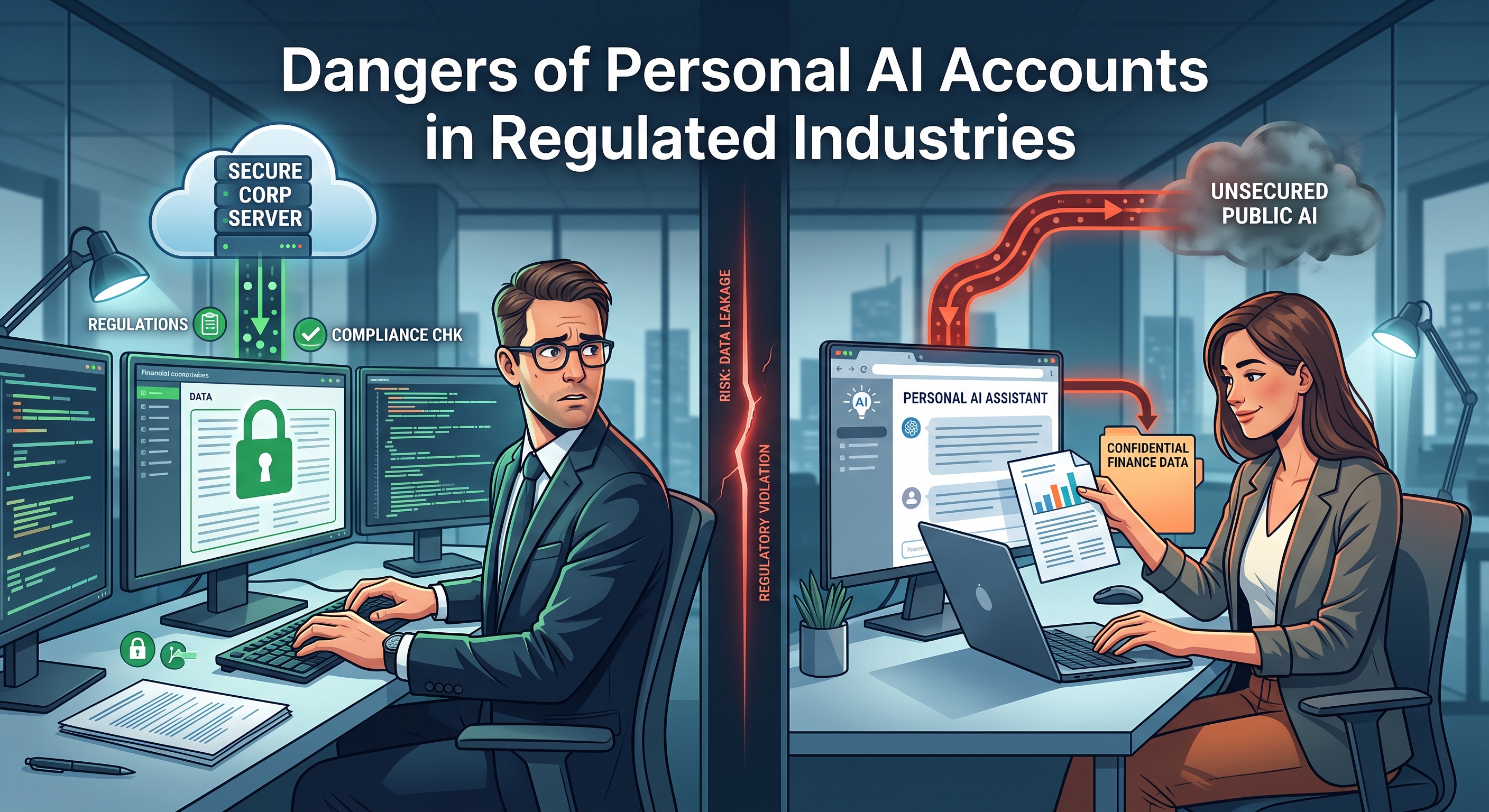
We are going to say something that will make a few compliance officers uncomfortable: right now, in a large number of CPA firms, law firms, and financial practices, employees are pasting client data into personal AI accounts. Not company accounts. Personal ones. Free ChatGPT logins tied to a Gmail address. Personal Gemini. Whatever they had open in the other tab.
We are not guessing at this. We see it firsthand when we onboard new clients and start looking at where company data is actually going. And in almost every case, nobody involved was trying to do anything wrong.
Let's be fair about the motive, because getting this wrong is how you end up with a policy nobody follows.
AI genuinely makes the work easier. A staff accountant can drop a messy trial balance into a chatbot and get a clean summary in ten seconds. A paralegal can paste a 40-page agreement and get an issue list back before the coffee finishes brewing. An advisor can turn rough meeting notes into a polished client email. That is real productivity, and the people using it are usually your best performers, the ones looking for a faster way to get through the work.
So they are not being reckless. They are being resourceful in an environment where nobody ever told them what the rules are, because the rules were never written.
That is the actual problem. It is not the technology. It is the absence of controls around it.
Here is the part most employees do not think about when they hit paste.
A personal, consumer-tier AI account is a personal account. The firm does not own it, cannot see it, cannot audit it, and cannot delete anything from it. When that employee leaves, their chat history walks out the door with them, and it may well contain client names, Social Security numbers, account balances, deal terms, or draft strategy.
Beyond that:
Every business should care about this. But if you are a CPA, an attorney, or in financial services, the exposure is a different category entirely, because you are not just protecting data. You are operating under a professional obligation to protect it.
The AICPA Code of Professional Conduct's Confidential Client Information Rule restricts disclosure of client information without consent. IRS Circular 230 governs your conduct as a practitioner. Internal Revenue Code Section 7216 attaches criminal penalties to the unauthorized disclosure or use of tax return information. And the FTC Safeguards Rule treats tax preparers as financial institutions, which means you are expected to maintain a written information security plan covering exactly this kind of thing.
None of those frameworks carve out an exception for "the employee only pasted it into a chatbot to save time."
ABA Model Rule 1.6 governs confidentiality of client information. Comment 8 to Rule 1.1 establishes a duty of technology competence. Rule 5.3 makes you responsible for supervising nonlawyer assistance. The ABA addressed generative AI directly in Formal Opinion 512 in 2024, and the through-line is that using these tools is not prohibited, but doing it without informed consent, supervision, and an understanding of where the data goes very much is a problem.
There is also the privilege question. Voluntarily disclosing privileged material to a third party invites an argument that privilege was waived. You may well win that argument. You should not want to have it in the first place.
SEC Regulation S-P, as amended, carries customer information safeguarding and incident notification obligations. FINRA Rules 3110 and 4511, along with SEC Rule 17a-4, mean supervision and books-and-records requirements can reach communications and business records that employees are now generating inside tools you have no visibility into. GLBA sits underneath all of it.
And if you operate in New York, as most of our clients do, NYDFS Part 500 applies to covered entities with real teeth, including risk assessment, access controls, third-party service provider policies, and senior officer certification. Certifying compliance while your staff runs client data through unmanaged personal accounts is not a position you want to be in.
The instinct for a lot of firms is to block the AI sites at the firewall and call it handled. That does not work. It pushes the behavior onto personal phones, where you have even less visibility, and it puts you at a competitive disadvantage against firms that figured out how to use these tools safely.
The answer is to give people a sanctioned tool that is better than the shadow one, and then put controls around it.
Business and enterprise tiers exist for exactly this reason: Claude Team and Enterprise, ChatGPT Enterprise, Microsoft 365 Copilot, Google Workspace with Gemini. These give you administrative ownership of the accounts, centralized identity and SSO, data handling terms written for business use, retention controls, and audit logging. Read the actual terms for the tier you are buying, and get a data processing agreement in place. If you handle protected health information, get a BAA.
The practical point is simple. If you provide a good tool, people use the good tool. If you provide nothing, people bring their own.
Not a memo. A signed policy that becomes part of the employee handbook and the onboarding packet. It should name which tools are approved, state plainly what categories of data may never be entered into any AI tool, require human review of AI output before it reaches a client, address disclosure obligations to clients where applicable, and spell out consequences. Signed acknowledgment matters, both for setting expectations and for demonstrating your program to an examiner.
A policy nobody enforces is a document, not a control. Layer in the technical side: SSO and conditional access so AI tools are reachable only from managed identities, admin-level settings that disable training on your data and set retention, data loss prevention rules that catch SSNs and account numbers before they leave, restrictions on connectors and file uploads, and monitoring so you can see which unsanctioned AI services are being reached from your network.
Ten minutes explaining what happens to a document after it is uploaded changes behavior more than a paragraph in a handbook ever will. Most people stop the moment they understand the mechanics.
This space moves fast. Approved tool lists, vendor terms, and risk assessments should get looked at at least annually, and more often if you are a covered entity under a framework that expects it.
It is the wild west. Data is moving in every direction, mostly by people with good intentions and no guardrails, and the firms doing it have no way to know the scope of their own exposure.
The gap is almost never awareness that AI matters. Everybody knows AI matters. The gap is controls. Company-owned accounts, a signed policy, organizational restrictions, and monitoring. That is the whole list, and most firms have none of it.
If you are a CPA, legal, or financial firm on Long Island and you are not sure what your team is putting into AI tools right now, we can find out and help you put a real governance program around it. Get in touch with MJN Technology Services and we will walk you through it.
This article is for general informational purposes and is not legal, tax, or compliance advice. Consult your own counsel or compliance professional regarding the requirements that apply to your firm.
Related for Long Island professional firms:
Questions? Contact MJN Technology.